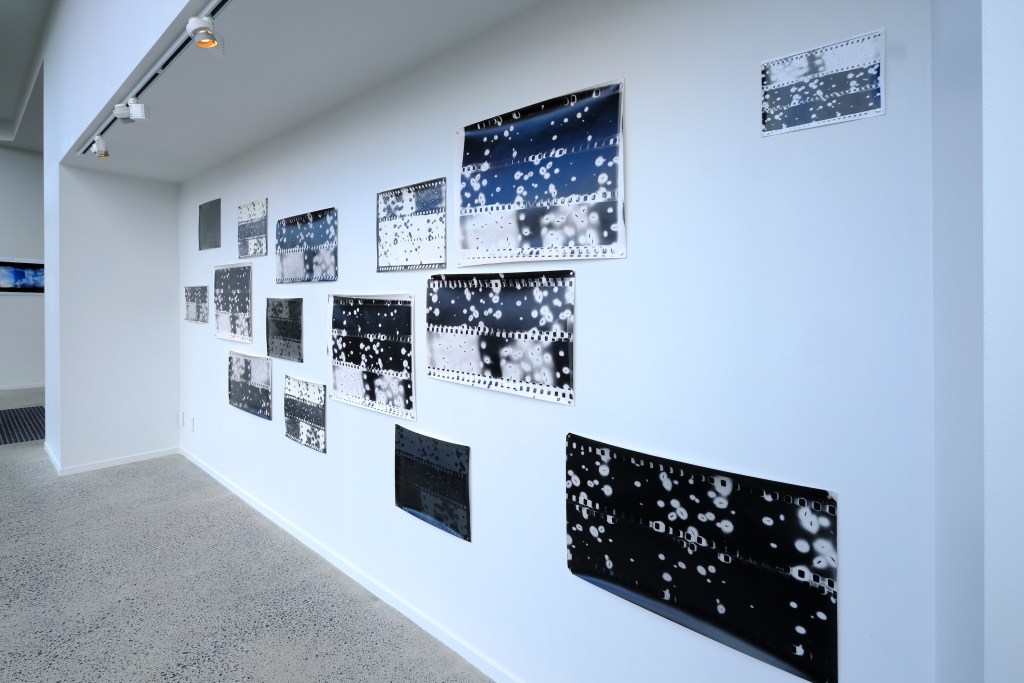
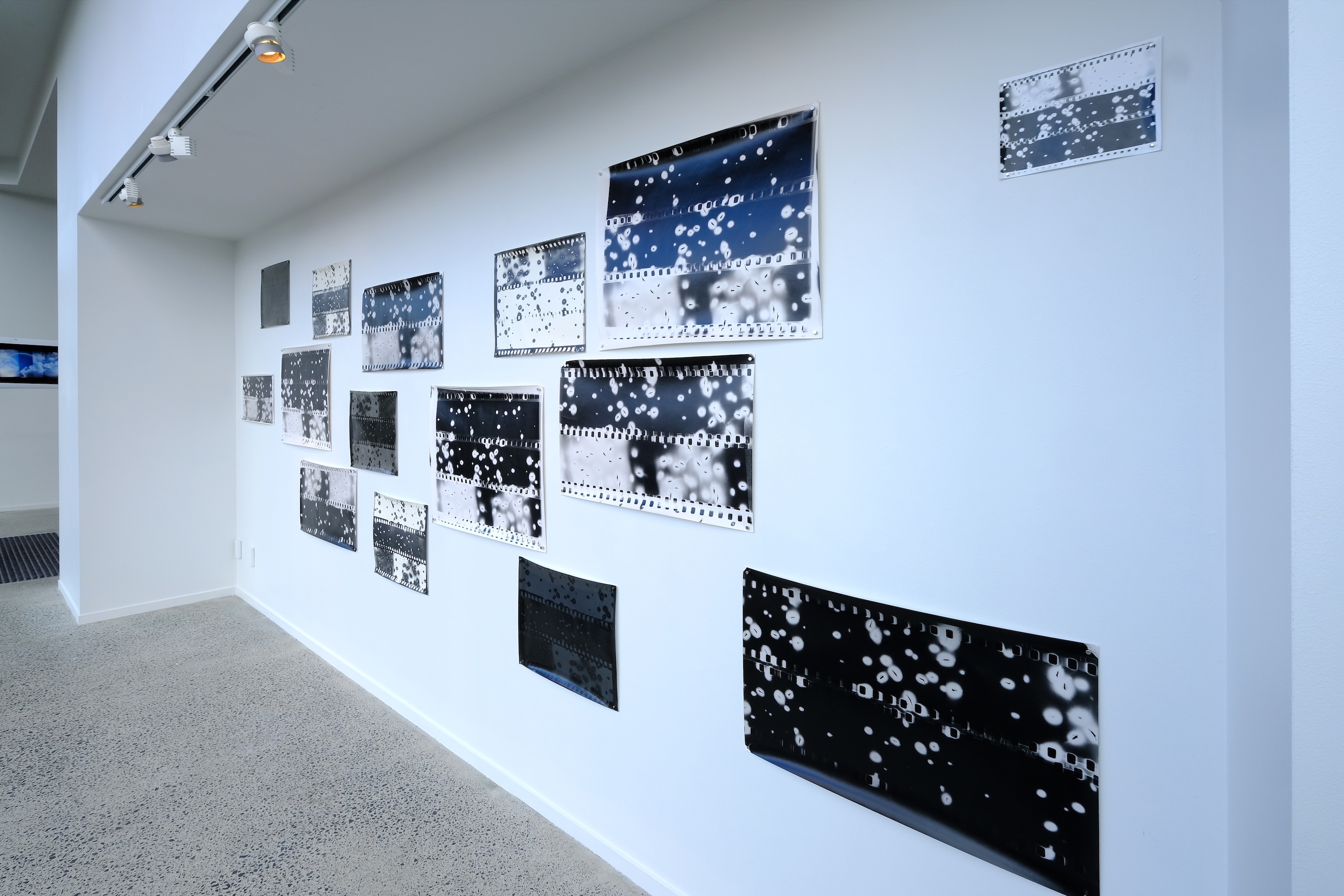
Lisa Benson makes photographs by gathering light with antique analogue technology, camera-less processes among them, and lets time, chance and failure do their share. Stellar Garden, at RAMP Gallery, proceeds as an open-ended experiment in perception: a unified field, approached through the local. Here, Elle Loui August responds to the exhibition, taking the sun as her starting point.
In early August 2026, the network of scientific bodies affiliated with the Inouye Solar Telescope released a collection of images of the surface — or perhaps it is more accurate to say, surface environment — of the sun. In one composite file uploaded to YouTube, the image zooms from a 1,400,000-kilometre-wide view to a relative ‘close-up’ at 800 kilometres, to reveal rivers of vortices lashed in energetic networks across the surface, neatly summarised by science communicator Michelle Starr as, “constantly evolving curlicues in the solar plasma.” Of these new images, it is these baroque whirling patterns, termed Kelvin-Helmholtz Instabilities (KHI), that have generated the most excitement in the scientific community. Starr observes:
If KHI are indeed so widespread across the Sun’s surface, they could be influencing the flow of energy through the solar atmosphere almost everywhere – mixing plasma and magnetic fields as they twist and break apart.
These images were fresh news when Bensen first contacted me, inviting me to respond to her forthcoming exhibition — how sympathetic her framework seemed to this recent image-event. She confessed to still being at work on an abstract meditation on photosynthesis, or at least this is how I began to interpret her notes and the images accumulating in my inbox. The work itself was stretched across time, developed and developing, accumulating, iterating, or submerged in fluids under infrared light in the Waikato. Phos/Graphe. The inscription of light. In this case, layered compositions of light, time and substance. I wondered if we have become so accustomed to reading the content of images over their form, that the more ancient or rudimentary origins of ‘light-writing’ slip too easily out of view. Might a photographer who turns back to this relationship be pursuing most simply a love of light? I receive a handful of new notes from Bensen, who writes now about breathing, suggesting that she is approaching the inter-space of Phos and Graphe as if pulsing with the life-world opened by Tāne, flowing with awen, mauri, life.
I am reminded by this correspondence of poet Fanny Howe’s writing on Jacques Lusseyran, a young Frenchman whose love of sunlight was cut short by an accident, leaving him blind at the age of eight. At first overwhelmed by an ocean of sound, Lusseyran soon started to ‘feel’ in colour, to sense in tones, ultimately locating a source of light within his own body. Howe writes:
He never gave the light divine attributes. He did not embellish his description of it with religious language. It was not a symbol, not a myth, not magic for him. It wasn’t a sign; It was as embodied as a spine.
The body, medium, techne and Te Rā are all implicated in the compositional structure of Bensen’s project. The images track years, moments, and at times near-unfathomable conceptual distances, the papers shuffling like leaves under the sun. They are aged, opened, weathered by design. Part map, part photographers’ scrapbook and gestural archive, inscribing presence, atmosphere, transience and distance. Documents that might say: my breath and attention are part of the shimmering respiration of the whole. I too have been listening to the light.
The Australian ecological ethnographer, Deborah Bird Rose, iterating on the Aboriginal concept of shimmer, suggests that such encounters with shimmer or bir’yun (brilliance) operate as aesthetic gateways to ‘ancestral power,’ calling us into multi-species worlds. For Rose, who first learned to experience this concept through dance and layered temporal patterns in connection with the earth, to shimmer in this sense is fundamentally interactive and ecological. One is lured, one partners with the vitality, the brilliance of life; ‘Brilliance allows you, or brings you, into the experience of being part of a vibrant and vibrating world.’
In Bensen’s images such lures into relation are at once visual and conceptual, recording processes of noticing and notating as she locates herself in a worldview akin to Rose’s conception of shimmer, finding concert with plumes of light and cloud, wavering trees, and in magnetic and dynamic relation with stellar light as it falls through the lens and settles on paper. Light, shadow, sensation. The arc of a silvered rainbow, tracing a way.
[1] The Max Plank Gesellschaft describes this as “a combination of data from the NASA/SDO satellite, the Inouye Solar Telescope VBI instrument, the MPS camera, and the HAO MuRAM simulation.” Max-Planck-Gesellschaft, ‘Tiny Vortices Discovered on the Sun’s Surface’, 5 August 2026, https://www.mpg.de/26900660/tiny-vortices-discovered-on-the-sun-s-surface. https://www.mpg.de/26900660/tiny-vortices-discovered-on-the-sun-s-surface
[2] Michelle Starr, ‘“Simply Astonishing”: Record-Breaking Images Reveal the Sun Is Teeming with Whirling Vortices’, ScienceAlert, 6 August 2026, https://www.sciencealert.com/simply-astonishing-record-breaking-images-reveal-the-sun-is-teeming-with-whirling-vortices.
[3] Ibid.
[4] Fanny Howe, Night Philosophy (Brussels: Divided Publishing, 2020), 6–12.
[5] Deborah Bird Rose, ‘Shimmer: When All You Love Is Being Trashed’, in Arts of Living on a Damaged Planet, ed. Anna Tsing, Heather Swanson, Elaine Gan and Nils Bubandt (Minneapolis: University of Minnesota Press, 2017), G51–G63.
[6] Ibid. G53.