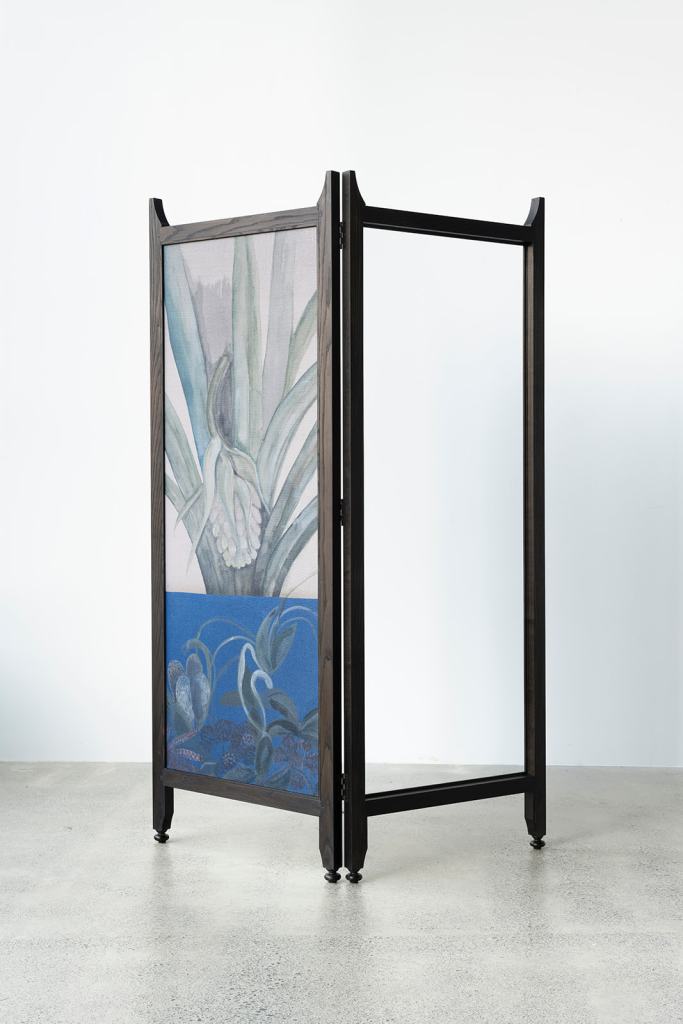

Holderness’s Botanical Correspondents at Sanderson (also presented earlier this year at Rokowhiria Ashburton Art Gallery) takes the nineteenth-century paintings of Emily Cumming Harris (1837–1925) as its starting point: dreamy yet scientifically precise depictions of Aotearoa’s indigenous plants. But Holderness’s project goes beyond homage, exploring how Harris’s botanical images might be reimagined and encountered today.

How did Emily Cumming Harris first enter your practice?
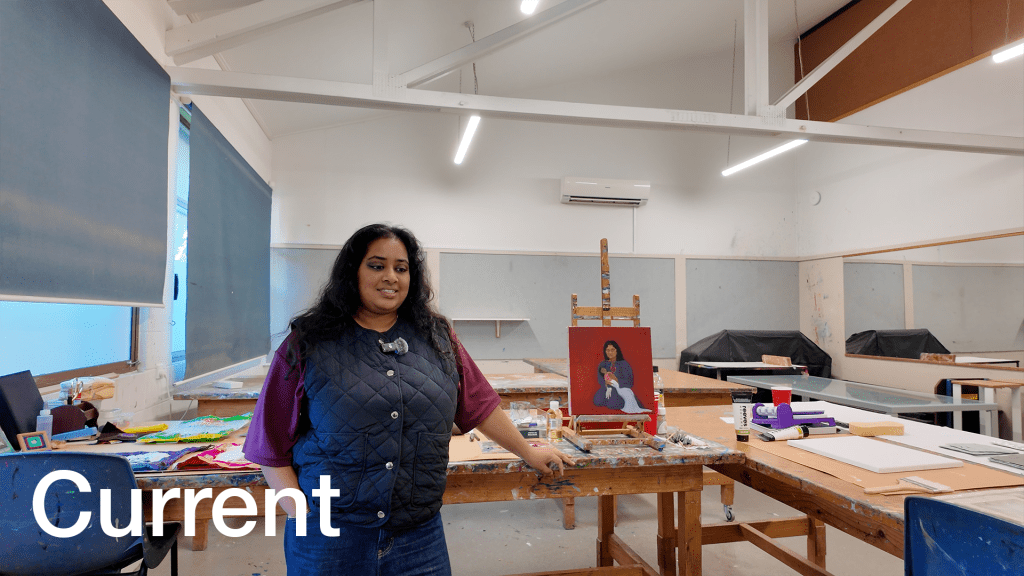
I was doing an art residency at Rangi Ruru Girls’ School, and wanted to begin a new body of work through experimentation. The school grounds are richly planted with native species and, with access to presses, I returned to printmaking, using plants directly in the press.
Around the same time, my mother showed me Lady Painters, a book about early women botanical artists, and reminded me that she had a print by one of the artists, Emily Harris, at home. I’d always been drawn to the image, which depicts the Rangiora plant, but had never looked closely at Harris herself. My mother told me the print had likely been purchased by Dora, my grandmother, from the National Library around 1968. That personal connection became the starting point for a much deeper investigation into Harris’s work and its place within Aotearoa’s botanical and artistic histories.
Once I started looking into Harris, I discovered a huge amount of research undertaken by Michelle Leggott and Catherine Field-Dodgson. When I contacted them, they told me they’d been hoping a contemporary artist might engage with her work. They became sounding boards throughout the project.
Rather than exhibiting Harris’s original paintings, you chose to work with later print reproductions. Why?
Initially I hoped to borrow two original works from The Suter’s collection, but I forgot that we’d need dim lighting, because they’re delicate works on paper.
I was drawn to the idea of circulation and dissemination, and that there must be thousands of her images around the country. Rather than treating Harris’s work as a rare archive, I became interested in its everyday afterlife. I located the full set of prints via various people and asked the lenders to contribute a short text about their relationship to the works. The exhibition became not only about Harris’s images but also about the communities that have carried them forward.
Harris’s work has a very particular look: backgrounds of muted colour, often overpainted with bright, ghostly white. Her work is quite dreamy, and sits somewhere between scientific observation and aesthetic interpretation. What draws you to that balance?
It’s apparent that Harris was not simply a botanical illustrator, she was an artist. She made decisions about how a plant could be composed in space. I felt an affinity with her, because she painted on coloured papers, which is something I do too.
There is romance to the way she depicts the plants. There are conventions that she follows, like trying to show the plant in different forms, but at other times she makes more artistic and compositional decisions that show she thought about the image as a whole.
Can you tell me more about the three spaces in the exhibition, Bush, Studio and Exhibitions?
These operate as responses to, and reconstructions of, Harris’s botanical world, incorporating fragments of her imagery. Bush is a video that imagines Harris collecting her own plant specimens, and Studio speculates what her working environment could have looked like. Exhibitions responds to a time when Harris staged an exhibition on her own terms in a school room in Taranaki. Her correspondence reveals that she was often disappointed with how her work was displayed in industrial exhibitions in Sydney, Melbourne, London, and New Zealand. Creating her own exhibition became a way of reclaiming agency over how her work was encountered.
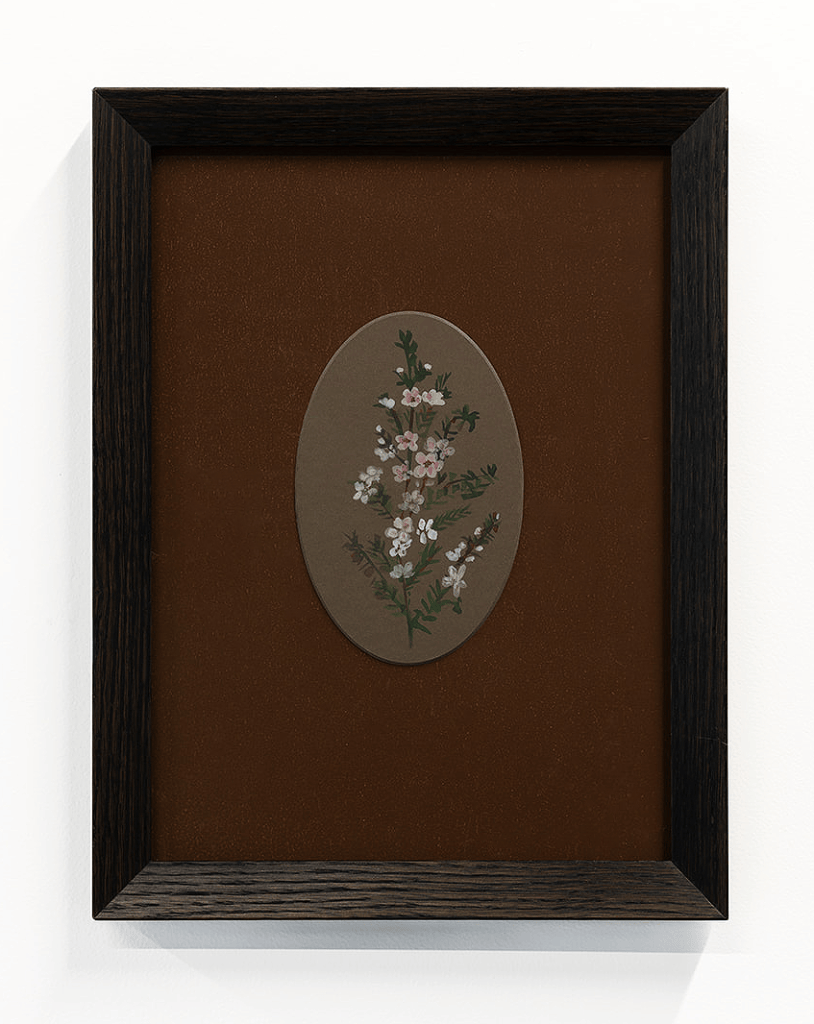
When writing to her sister about this show in Taranaki, she describes arranging the room ‘like a little drawing room’, complete with a makeshift mantelpiece. I became intrigued by this carefully staged drawing room, and I made a series of works in response to this idea. The Victorians were maximalists! For this installation, I’ve created a salon hang of works that reinterpret Harris’s. I’ve included a cameo-shaped portrait of Harris in a vitrine — a format that’s echoed in some of my plant studies.
On view at Sanderson
26 AUG – 14 SEP 2026