City Gallery Wellington Te Whare Toi reopened its heritage building in Te Ngākau Civic Square on 10 October, following a two-year closure, with a major exhibition by British artist Cornelia Parker. Bringing together more than 50 works spanning sculpture, installation, photography, video and works on paper, the presentation marks Parker’s first solo public gallery exhibition in Aotearoa New Zealand.
Parker’s practice often begins with familiar materials subjected to extraordinary processes. Objects are exploded, compressed, burnt or otherwise transformed, then reassembled into works that shift between destruction and renewal. Her installations make the aftermath of an event tangible, inviting viewers to reconsider the histories and associations carried by ordinary things.
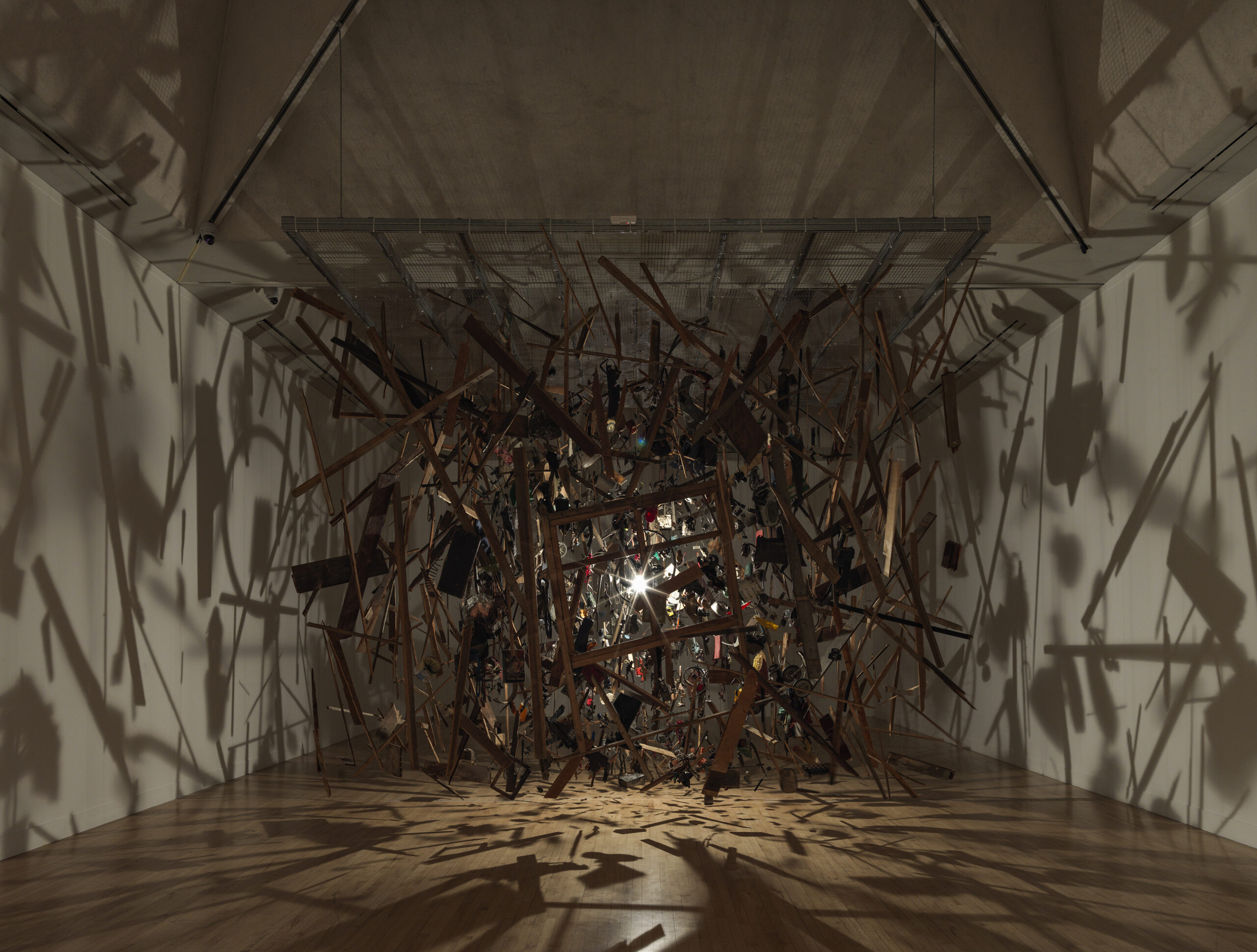
Among the exhibition’s central works is Cold Dark Matter: An Exploded View (1991), an exploded garden shed suspended around a light bulb. Other significant installations include Thirty Pieces of Silver (1988), Perpetual Canon (2004) and War Room (2015). Together with more recent projects, these works trace a practice in which material transformation becomes a means of examining political, social and cultural conditions.
The exhibition also includes THE FUTURE (Sixes and Sevens) (2023), a video installation made with schoolchildren reflecting on their futures amid political instability and the climate crisis. The work brings a contemporary urgency to Parker’s longstanding interest in uncertainty, change and the possibilities of reconstruction.
For gallery director Charlotte Davy, the exhibition provides a significant opening statement for the institution’s return. “This is the biggest show that New Zealand will have seen in years,” she said in the gallery’s exhibition announcement.
Parker, meanwhile, connected the reopening itself to the themes of her work. “Something paused, now back,” she said, describing the gallery’s return as a story of transformation and renewal.
The exhibition runs until 7 March 2027, occupying the gallery with a survey that brings established works into dialogue with more recent projects. Its opening marks not simply the return of a Wellington institution to its original home, but a renewed opportunity for audiences in Aotearoa to encounter one of Britain’s most significant contemporary artists.